Saleor vs Magento
Magento was a pioneer. It proved open-source commerce could compete with proprietary platforms. But the architecture that made it revolutionary in 2008 is the architecture that holds teams back in 2026 — tightly coupled, hard to upgrade, and increasingly expensive to maintain.
Both platforms are open source. The difference is what that means in practice. One is a modern API you build on. The other is a monolith you maintain.
Integrate in any language
It doesn't matter what Saleor is built in — you talk to it over GraphQL. Storefronts, extensions, and integrations can be written in TypeScript, Go, Rust, Python, PHP, or whatever your team already uses. (For the curious: the core is Python and Django — a mature, AI-friendly stack with a huge talent pool — but you never have to touch it.)
PHP or bust
To extend Magento you write PHP — with dependency injection, XML configuration, observers, and the EAV data model. The pool of experienced Magento PHP developers is shrinking and expensive, and there's no way to opt out of the stack.
API-first, headless by design
Every capability is available through a single GraphQL API. Storefront, admin, webhooks, extensions — all through one consistent, type-safe interface.
Frontend coupled to backend
Magento's architecture was designed as a monolith. Headless is bolted on — REST natively, GraphQL as an add-on with partial coverage. Two API surfaces, different capabilities on each.
Open standards everywhere
GraphQL for APIs. Python for the engine. OpenTelemetry for observability. OAuth for auth. Any frontend framework. Every layer uses industry standards — nothing proprietary.
Platform-specific at every layer
PHTML templates. XML layout configuration. Magento-specific module structure. KnockoutJS/RequireJS on the frontend. Each layer requires Magento-specific expertise.
Extensions decoupled from core
160+ webhooks, synchronous callbacks, dashboard extensions. Build in any language. Extensions run independently — they can't break the core and the core can't break them.
Plugins tightly coupled to core
Magento's plugin system hooks directly into core classes. One extension can break another. Upgrades frequently break plugins, and untangling conflicts is a specialty skill.
True SaaS — multi-tenant and versionless
Saleor Cloud is multi-tenant, auto-upgraded, and managed end-to-end. You don't own a codebase, you don't deploy it, and you don't upgrade it. Subscribe and build on the API.
Cloud in the name, not in the architecture
Adobe Commerce on Cloud is a single-tenant licensed Magento codebase running on Adobe's managed AWS — PaaS, not SaaS. You still own the code, the extensions, and the upgrades. Adobe's first true SaaS tier (ACCS) shipped June 2025 and isn't yet standard for mid-market merchants.
Painless upgrades
API-first architecture means core upgrades don't touch your storefront or extensions. Semver versioning, clear deprecation policies, and no plugin dependency chains.
Every upgrade is a project
Major version upgrades are effectively replatforms. Even minor versions break extensions. The official Upgrade Compatibility Tool exists because manual debugging is otherwise required.
Security patches in hours, not weeks
Decoupled architecture reduces attack surface. Core patches deploy independently of your storefront. No plugin compatibility testing required for security updates.
4–6 security patches per year, each a project
Each patch requires 2–5 developer days of testing against your extensions. March 2026 alone brought critical XSS and authorization bypass CVEs across all supported versions.
One backend, many channels
B2C, B2B, marketplace, multi-region — all from a single instance with per-channel configuration for pricing, inventory, currencies, and languages.
Multi-store with shared complexity
Magento's multi-store supports multiple storefronts, but they share the same monolith. More stores means more plugin conflicts, slower performance, and compounding configuration debt.
Commerce as Code
Version-controlled configuration. CI/CD pipelines. OpenTelemetry observability. Treat your commerce setup like any other critical infrastructure.
Admin panel and XML
Configuration split between admin GUI and XML files. No native version control for store settings. Deployments require careful coordination between code and database state.
AI agents build with you
Open source means full codebase visibility for AI coding tools. GraphQL introspection gives agents the complete schema. .claude/skills ship with the storefront.
AI agents struggle
The codebase is enormous, tangled, and full of implicit conventions — XML configuration, plugin interception chains, and EAV make it hostile to AI coding tools.
Portugal's largest electronics retailer moved from Magento to Saleor

“
It got crazy. A major Magento upgrade tied up two developers for an entire month — and the DX was so terrible we had trouble retaining PHP developers.
Helder Rocha, Managing Partner & CSO at Skrey
The agency that migrated PCDIGA from Magento to Saleor
Products
Faster requests
Unplanned downtime
Where your Magento team spends its time
Magento teams don't lack talent or ambition. They lack time — because the platform consumes it. Here's what keeps them busy instead of building features.
Security patches
4–6 per year, each requiring 2–5 developer days of extension compatibility testing. Miss one and you're running known vulnerabilities in production.
Extension conflicts
Plugins hook directly into core classes. One update breaks three extensions. Untangling conflicts is specialized, expensive work that adds no customer value.
Version upgrades
Major upgrades are replatforms in disguise. Even 2.4.7 to 2.4.8 requires Composer dependency resolution, PHP version coordination, and extension re-validation.
Performance tuning
Varnish, Redis, Elasticsearch, full-page cache — Magento requires a complex infrastructure stack just to achieve acceptable page load times.
API-first, everything decoupled
Monolith with everything interleaved
What a $15M brand actually spends each year
Both platforms charge for the commerce engine. The difference is what sits on top. At $15M GMV, Adobe Commerce's license is only ~40% of actual spend — the rest is labor to keep a licensed, single-tenant Magento codebase alive: patching, extension compatibility, version upgrades, agency retainers. Saleor Cloud is true SaaS, so those labor lines don't exist.
All-in monthly pricing. Includes up to $1M/mo GMV ($12M/yr) and generous API usage. Pricing
$3M above the $12M/yr included in the Volume plan. Enterprise rate negotiable — as low as 0.2%. Pricing
Core patches deploy independently. No extension testing labor. $0 extra.
No marketplace fees, no agency retainers for patching. Extensions are your own apps.
No Varnish, Redis, or Elasticsearch to manage. Auto-scaling, CDN, backups included.
Saleor Cloud has real costs — subscription plus GMV overage. But with zero labor for patching, zero extension licensing, and zero infrastructure management, the total is predictable and the savings compound every year.
Bundled license + managed AWS hosting + Fastly CDN + New Relic. $15M sits at the floor of Adobe's $15–$50M pricing tier. Partner estimates converge at ~$120K for this tier.
~75 developer hours/yr for scheduled patching and extension compatibility testing at $100–$200/hr — a benchmark confirmed by partners who run these cycles for mid-market merchants. Source
A typical mid-market store runs 10–20 extensions (search, ERP/CRM connectors, shipping, tax, B2B) with annual renewals and compatibility maintenance. Source
Minor upgrades $5K–$20K each; a major upgrade every 2–3 years runs $30K–$100K. Custom modules, themes, and extensions all need retesting. Source
$3K–$8K/mo for performance tuning, extension conflict resolution, and small feature work — the standard retainer band for mid-market Adobe Commerce stores. Source
Before implementation costs ($100K–$250K+ for a mid-market build). Adobe Commerce on Cloud is a managed PaaS, not SaaS: the merchant still owns application upgrades and extension compatibility. Adobe's true SaaS tier (ACCS) shipped June 2025 but isn't yet standard for mid-market merchants. On-premise drops the license to ~$75K/yr but adds $24K–$100K/yr of hosting, DevOps, and PCI compliance. Magento Open Source removes the license entirely but keeps every labor line above.
Implementation is bounded and rebated.
A one-month Forward Deployed Engineering sprint gets your store live on the $3,999/mo Volume plan — $18K upfront for Accelerator + FDE, 100% credited back as $1,500/mo over year 1. The engineers who wrote Saleor close engine-level capability gaps alongside your team or your agency partner.
See Commerce made-to-measureWhere Magento wins
Magento has been around since 2008. That longevity built real depth in areas Saleor approaches differently.
Adobe ecosystem lock-in
If you're already invested in Adobe Experience Cloud (Analytics, Target, AEM), Commerce plugs in natively. Saleor integrates with best-of-breed tools but doesn't have that single-vendor cohesion.
Extension marketplace
Magento Marketplace has thousands of extensions for every use case. Saleor's ecosystem is smaller — you compose from best-of-breed services or build custom via the API.
Visual page builder
Magento's Page Builder provides drag-and-drop content editing inside the admin. Saleor models content through attributes and product types — structured data that any frontend or CMS can consume, but no built-in visual editor.
Your team already uses AI coding tools.
Does your commerce platform work with them?
AI doesn't fix bad infrastructure — it amplifies it. Magento's XML configuration, plugin interception chains, and EAV data model are hostile to AI coding tools. Saleor's clean API and open source code are exactly what they need.
Open source = full visibility
AI coding agents working on a Saleor project can read the entire commerce engine source code — clean Python, not a sprawling PHP monolith with implicit conventions that trip up both humans and machines.
GraphQL-native = self-documenting API
Introspection gives AI agents the complete schema — every type, field, and relationship — in machine-readable format. Correct queries on the first try. Not REST with partial GraphQL coverage.
Commerce as Code = AI-native config
Version-controlled YAML configuration that AI agents can read, modify, and submit for review. Not XML spread across dozens of module directories.
AI skills ship with the storefront
Saleor's reference storefront includes .claude/skills — so AI agents already understand checkout, variants, and caching architecture.
Don't take our word for it. Clone the Apps or the Storefront, open Cursor, and ask it to build something.
We ship agent skills for the platform and storefront skills so AI tools understand Saleor out of the box. Then try the same with your Magento codebase.
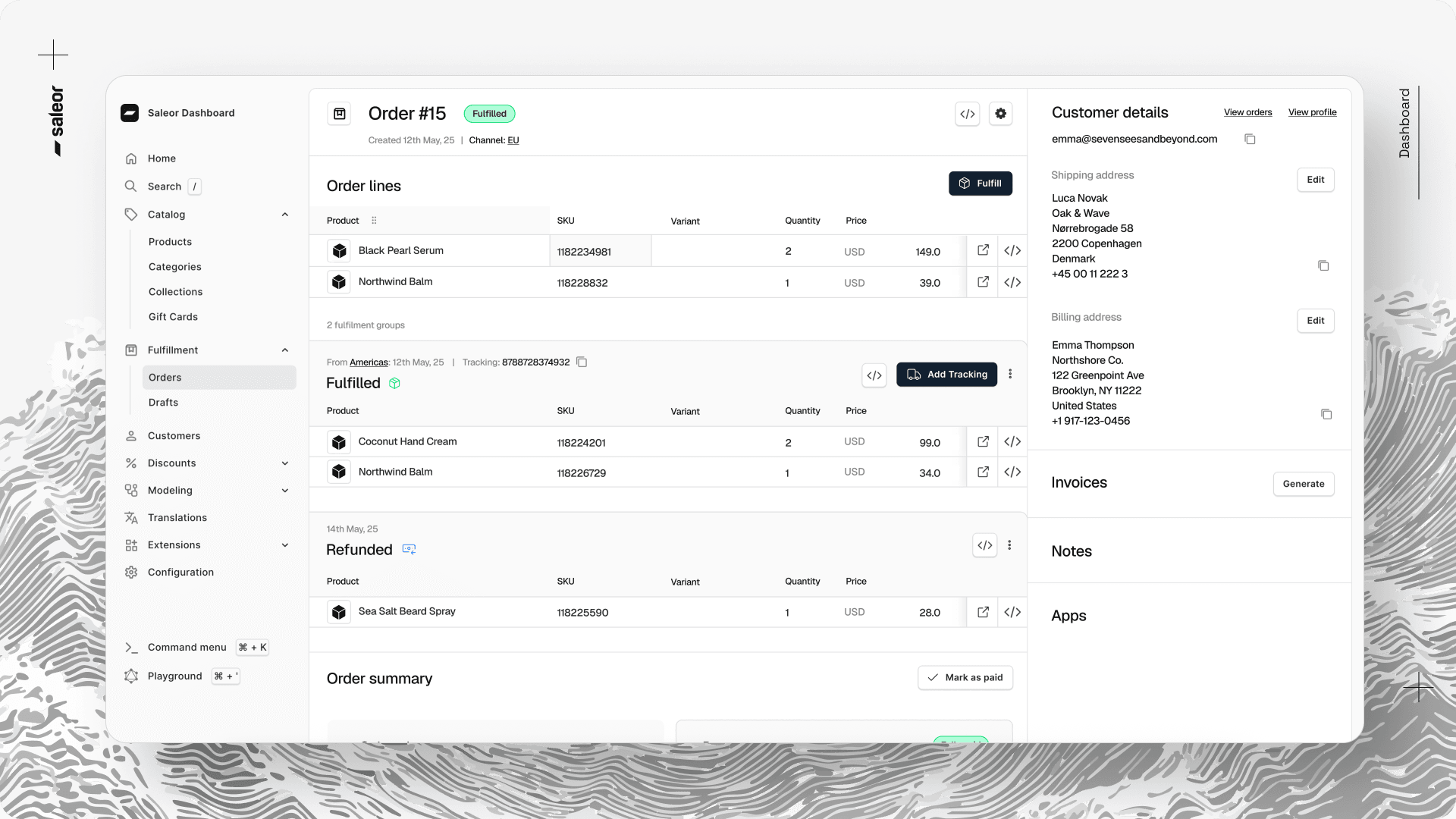
A modern admin your team will actually enjoy
Saleor Dashboard is a React app with 45+ extension mount points — fast, responsive, and built for how operations teams work today. Not a PHP-rendered backend from 2015.
You don't have to migrate everything at once
The strangler pattern works. Run Saleor alongside Magento — power a new channel, a new market, or a new brand while Magento handles the rest. Migrate at your own pace, validate as you go.
The best way to evaluate Saleor is to use it
Start a free cloud sandbox, explore the API, or talk to our engineering team. No pitch decks — just commerce infrastructure you can verify yourself.