The Open End-to-End AI Ecommerce Stack
Search redefined discovery. Mobile redefined UX. Agents redefine the interface to commerce. Saleor is the first fully open, end-to-end AI-native commerce stack.
Search
redefined discovery.
Mobile
redefined UX.
Agents
redefine the interface to commerce.
The API is becoming the real storefront.
Origin
When we started building Saleor, we didn't think in templates. We thought in state, flows, eligibility. Commerce for us was explicit rules and deterministic transitions — infrastructure, not UI.
That decision matters more today than ever.
Because when commerce is structured, inspectable, and API-first, it becomes naturally compatible with agents.
We didn't pivot into AI.
We were built for it.
Announcement
Saleor is the first fully open, end-to-end AI-native commerce stack — from agent entry point to storefront UX to transactional core and developer tooling.
The Right AI Ingredients
Modern commerce is multi-
channel, multi-device, multi-intent.
AI buying agents are not an experiment. They are another door to your business. An autonomous storefront.
Context
The question isn't "should we add AI?" The question is: is your commerce engine compatible with it?
Long-term AI leverage does not come from chat widgets. It comes from clean, well thought-through architecture. Bet on API-first, openness, minimal lock-in, and dev velocity.
API-first
Saleor's GraphQL API is self-describing, introspectable, and type-safe. Agents can navigate it comfortably and safely.
Open Source DX and AX
Both developers and agents benefit from inspectable systems. With the source available, AI will never get stuck on "how does it actually work." Queries and mutations can be verified against real structure, not guesswork.
Commerce as Code
Configuration in version-controlled files. Reproducible. Reviewable. Testable. Native surface for coding agents.
Ownership
As new entrance doors appear — agents, marketplaces, AI platforms — control over your core commerce engine becomes more valuable, not less. Let others send customers. Don't let them own your store.
You are the platform ↗
Agentic Commerce
A New Entry Layer
As new entrance doors appear — agents, marketplaces, AI platforms — control over your core commerce engine becomes more valuable, not less.
Let others send customers. Don't let them own your store.
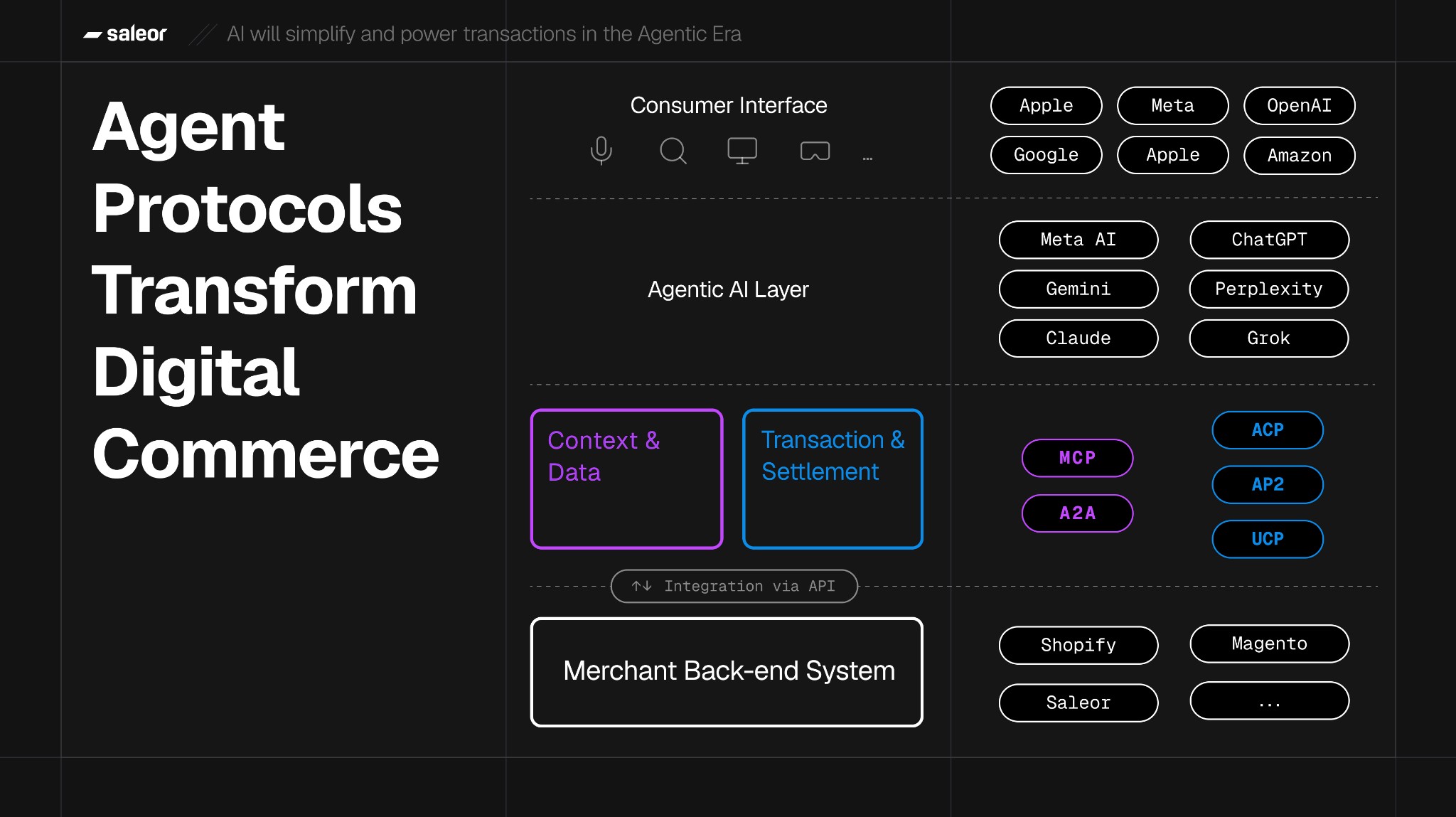
Agents come next — with platforms like ChatGPT by OpenAI, Gemini by Google, and Perplexity already reshaping intent expression. Protocols become storefronts.
Saleor was the first open commerce platform to implement ACP.
Agentic Commerce Protocol was first, UCP and AP2 are coming next.
Expose selected products to agents.
Respect channel-level pricing and promotions.
Remain inventory-aware.
Route transactions through your existing checkout and payment flows.
Read more about Saleor ACP support ↗
Compatibility
If you run Shopify, Salesforce Commerce, Adobe Commerce, commercetools, WooCommerce, or any other legacy system, you can start with Saleor by using the agentic layer app and evolve from there. No replatforming required.
Most AI commerce products are overlays on top of legacy systems.
Saleor can act as the structured commerce engine beneath them - exposing catalog and pricing to agents, routing orders through to the old/existing systems, and gradually taking over core logic without forcing a replatform.
Saleor Ink AI
Composable Conversational Storefronts, Fully Grounded
Agent compatibility is only the entry layer. Once users arrive — what happens next?
Problem
We want to buy better products at a better price tag. But we also want to buy the right products — without making a PhD in understanding their pros, cons, and applications. Storefronts need to get good at surfacing qualities and reasoning over intent. The good part is — it's now easier than ever.
Search stopped being keyword matching. It becomes personalized, generated UI, and structured reasoning over intent and real inventory.
Let your customers surface the relevant products and information fast in the context of your own storefront. But also, let them have a well designed UI when the right data and context is already surfaced.
We're rolling out
Saleor Ink AI to our first pilot customers.
Join our beta, and build it with us ↗
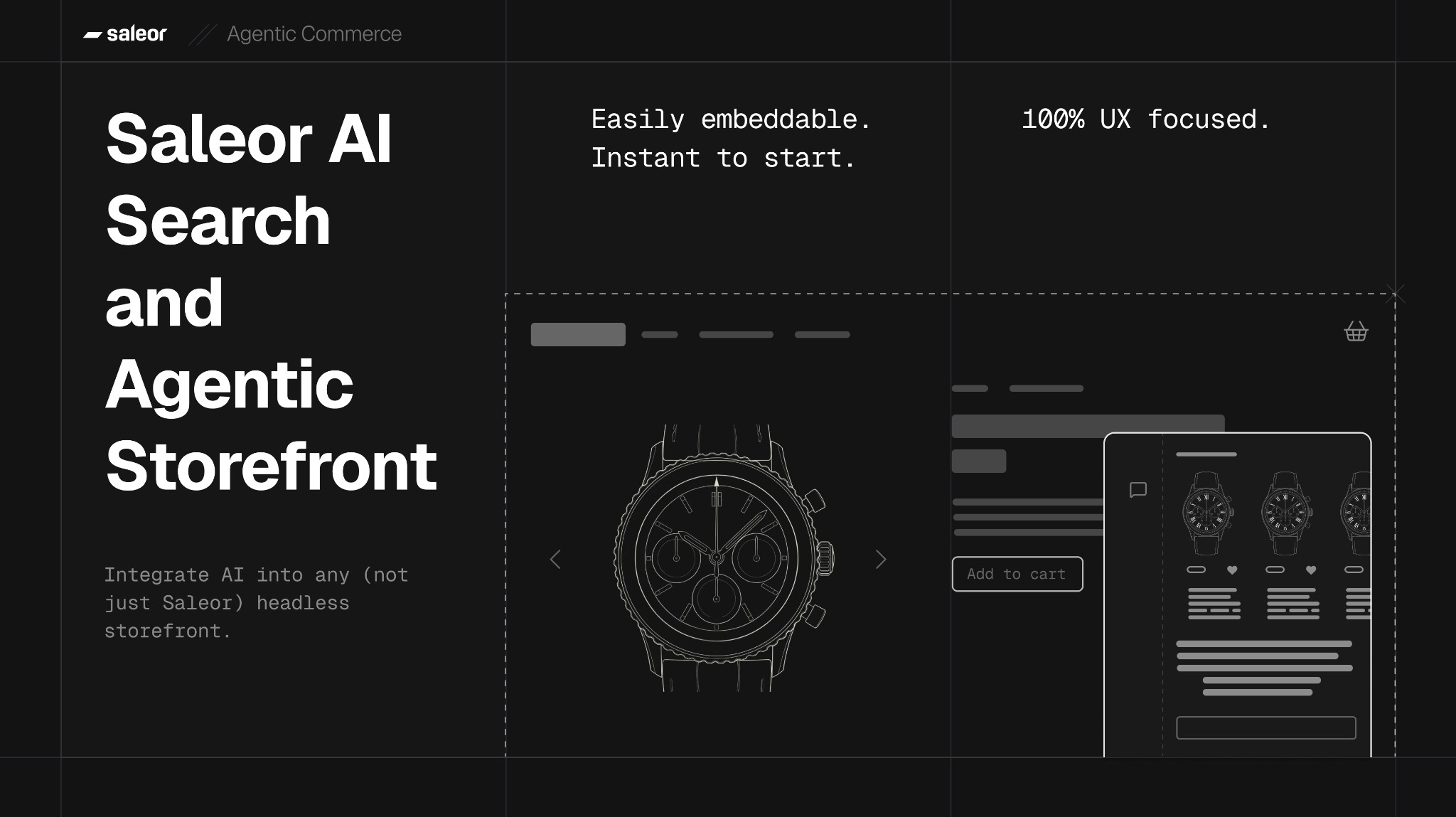
Ink AI extends any headless storefront with conversational search that can be deeply embedded as part of a one fluid UX.
Ink AI is built with the same mindset as the rest of our stack: open, composable infrastructure by default. We've partnered with Typesense to power it. No black boxes or unclear pricing.

What makes it different
Fully grounded in your real inventory, pricing, and channel rules.
Built on one of the most powerful commerce APIs. Not back-end duct tape.
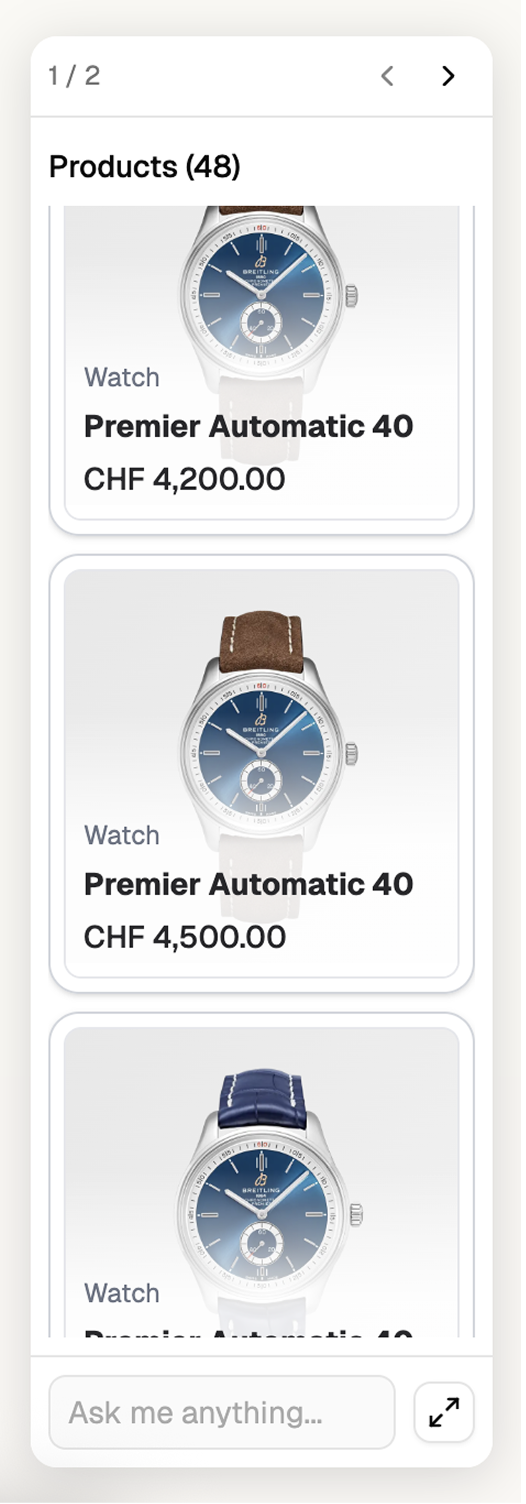
Embeddable as a chat interface or as a search replacement.
This is not "chat in a corner."
It's a new UX primitive for commerce — one that coexists with your PDP, your checkout, your brand.
Ink AI can be both used as a branded chat window or as a replacement/extension for your search input.
Beta
Join the Ink AI beta. Work directly with our team to design brand-aligned AI UX, improve your product data with intelligent enrichment, and replace traditional search with a contextual, personalisable AI layer.
Experiment without breaking checkout.
Control what agents see and sell.
Maintain ownership of data and payments.
Upgrade discovery without replacing your core systems.
Ink AI (codenamed "🏴☠️ Pirate AI") evolved from our Buy AI project/lab. The aim is to leverage Saleor’s robust commerce API for AI-native workflows — enabling structured access, data enrichment, and controlled execution for agents. Join our Beta as one of the first and help us improve it!
Development Velocity
The Structural Advantage
AI does not remove the need for correctness. It increases it.
Saleor is built for the moment when design and business decisions, once fluid, become customer-facing code that must be correct. And iterating over those decisions has become easier than ever. The constraint in development is shifting from manual coding to architectural quality.
When paired with structured APIs, modern coding models like Opus 4.5+, Gemini 3 Pro, or GPT 5.3 Codex compress months of work into days — but only if the underlying system is clean.
We don't believe the world needs another vibe-coding tool producing clunky storefronts that look great in a showreel. Real companies require sustainable development practices, strong architecture, and long-term thinking — they just deserve to experiment at the speed of thought, without artificial constraints.
The Stack
Conversational storefront layer. Easily embeddable. UX-focused. Built on robust foundations.
Agent entry layer. Soon also supporting UCP and AP2.
Saleor's GraphQL API is self-describing, introspectable, and type-safe. Agents can navigate it comfortably and safely.
Infrastructure as Code applied to commerce. Define everything in version-controlled files and sync to your Saleor instance. Easy to handle by coding agents, and comming with Saleor Configurator Claude Plugin included.
Production-ready storefront foundation with built-in AI skills. Semantic, concise documentation in
.claude/skills —
covering checkout architecture, variant selection, caching strategy, and more — so AI agents and
developers understand how things actually work.
Clean extensibility surface for safe evolution. Extensibility decoupled from the core — a safer, more efficient surface for coding agents to build on.
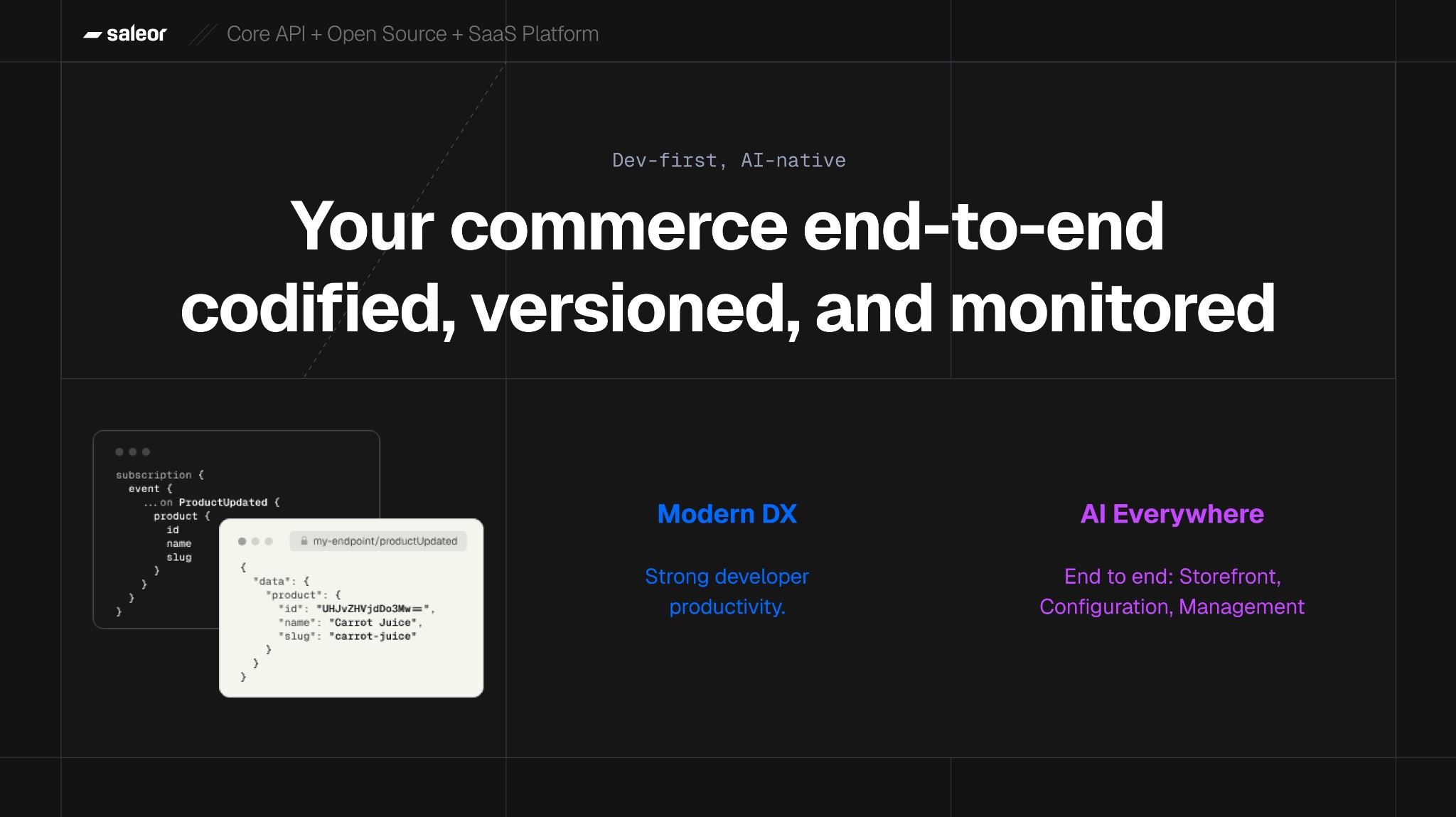
The Shift Is Structural
Agents will become a primary entry point.
Conversational UX will become normal but not an exclusive and only UX.
Commerce engines will need to be structured, inspectable, and extensible.
The infrastructure underneath it must change too.
What's next
We built Saleor for that moment from day one.
If you're a technical leader evaluating your AI strategy, or a brand ready to experiment without losing control — this is the layer to build on.
The next generation of commerce is only a chat away with our team.
The next generation of commerce will not be chat overlays.
It will be architecture.