Saleor vs Shopify
Shopify is a great product. It made commerce accessible to millions. But accessibility and control are different things — and at some point, the platform that got you started becomes the platform that holds you back.
This page compares philosophies, not features. Features change quarterly. Architecture decisions compound for years.
|Open source
BSD-3 license. Read every line of code. Fork it, audit it, self-host it. Your commerce engine is yours — no one can change the terms on you.
Proprietary
Closed-source backend. You build on Shopify's platform, under Shopify's rules. Policy changes, pricing updates, and feature deprecations are outside your control.
Open standards everywhere
GraphQL for APIs. Python for the engine. OpenTelemetry for observability. OAuth for auth. Any frontend framework. Every layer uses industry standards — nothing is proprietary to Saleor.
Proprietary at every layer
Liquid for templates. Proprietary SDKs for extensions. Polaris components required for admin apps. Shopify CLI for tooling. Each layer ties you deeper into one vendor's ecosystem.
GraphQL-native
One API for everything — storefront, admin, webhooks, extensions. Type-safe, introspectable, self-documenting. Zero artificial rate limits.
Multiple API surfaces
Storefront API, Admin API, and Checkout Extensions each with different capabilities and rate limits. Hitting throttle limits during peak traffic is a known pain point.
Fully headless checkout
Build any checkout flow on any device. Single-page, multi-step, embedded, in-app — no restrictions on UX or payment orchestration.
Managed checkout
Shopify controls the checkout experience. Customization requires Checkout Extensions with sandbox restrictions on network requests, memory, and execution time.
No transaction fees
Use any payment provider without additional charges. Your margins are yours. Ideal for payment orchestration and complex multi-provider setups. At $15M GMV, that's $30,000/year you keep; at $100M GMV, $200,000/year.
Transaction fees on external payments
Using a payment provider other than Shopify Payments incurs a 0.2% fee on every order — on top of the provider's own fees and your subscription. At $15M GMV, that's $30,000/year in platform surcharges alone; at $100M, $200,000.
Extend with any stack
160+ webhooks, synchronous callbacks, dashboard extensions. Use Python, Node, Go, Rust — whatever your team knows. Extensions are decoupled from the core.
Extend in Shopify's ecosystem
Shopify Functions run in a restricted WebAssembly sandbox. Checkout extensions use a proprietary SDK with enforced constraints on what you can build.
Your admin, fully extensible
45+ mount points, technology-agnostic. Build full custom views with any frontend stack via the admin bridge — not just inline blocks on existing pages. Your admin extensions are real applications.
Decorate Shopify's admin
Admin UI Extensions let you add inline cards and menu actions using Shopify's proprietary web components and Preact. No full custom pages. Merchants must manually pin each block. You're decorating their pages, not building your own.
One backend, many channels
B2C, B2B, marketplace, multi-region — all from a single instance with per-channel configuration for pricing, inventory, currencies, and languages. Adding a new market is configuration, not infrastructure.
Multi-market with limits
Shopify Markets helps, but deeper customization often requires separate stores per market — duplicating catalogs, themes, and app licenses. 5 markets means 5x app spend, 5x config drift, and exponential operational complexity.
Commerce as Code
Version-controlled configuration. CI/CD pipelines. OpenTelemetry observability. Treat your commerce setup like any other critical infrastructure.
Console-driven operations
Configuration lives in admin panels. No native version control for store settings, no built-in CI/CD, limited observability into the platform internals.
AI agents build with you
Open source means full codebase visibility for AI coding tools. GraphQL introspection gives agents the complete schema. .claude/skills ship with the storefront.
AI agents work blind
Proprietary backend that AI tools can't inspect. Coding agents generate against documentation and hope — they can't verify behavior against actual source code.
A €5B unicorn moved from Shopify to Saleor

“
I'm impressed on how you steadily close the gap with the e-commerce leader. I now officially miss only one feature from Shopify.
Senior engineer at
After migrating from Shopify to Saleor
Valuation
Members
Countries
Shopify is great until you need
Custom checkout logic
B2B pricing tiers, configurable products, multi-entity tax scenarios, or server-side logic mid-checkout. Shopify's extensibility model doesn't allow it.
15+ international markets
Shopify Markets helps with a few regions. Beyond that, you're managing separate stores, duplicating everything, and praying configs stay in sync.
High-volume API operations
Real-time inventory sync across warehouses, catalog automation, or ERP integrations at scale. Rate limits add engineering complexity you didn't budget for.
True data ownership
Your customer data, order history, and product catalog live on Shopify's infrastructure, governed by Shopify's terms. Migrating out is an extraction project.
One instance, many channels
Markets for basics, separate store when it gets real
What a $15M brand actually spends each year
Saleor's Volume plan rewrites the whole stack: a single all-in subscription, a predictable 0.4% GMV overage, no payment-provider surcharge, and no per-store app multiplier. Month-to-month — no 3-year contract, no forced platform migrations in 2026.
Every Plus merchant at $15M GMV knows this stack: a base subscription signed on a 3-year term, a variable platform fee (0.25% above $1M/mo, whichever is higher) that scales as you grow, a 0.2% surcharge on every order not processed through Shopify Payments, and an app stack that multiplies the minute you launch a second store.
Every number below is sourced from 2026 Shopify-partner agencies and Shopify's own documentation.
$3,999/mo all-in. Includes up to $1M/mo GMV ($12M/yr) and generous API usage. Month-to-month — no 1-year or 3-year contract required. Pricing
$3M above the $12M/yr included. No "whichever is higher" clause, no hidden cap climbing toward $480K/yr at scale. Enterprise rate negotiable — as low as 0.2%. Pricing
No 0.2% tax for "not using our payments." Run Stripe, Adyen, a regional processor, or multiple in parallel — Saleor takes no cut on top of your processor's rate.
One instance runs unlimited channels — US/UK/EU, B2C/B2B, retail/wholesale. Klaviyo, Gorgias, and the rest bill once against one API, not one per store.
No variable platform fee, no third-party gateway surcharge, no per-store app duplication, no forced checkout or scripts migration.
Ships with a month of Forward Deployed Engineering — the engineers who wrote Saleor, building the integrations and extensions your business needs. How it works →
$2,500/mo on a 1-year term, or $2,300/mo if you lock into a 3-year contract. Source
0.25% of monthly GMV replaces the flat fee once sales cross the ~$1M/mo threshold — whichever is higher. $15M/yr sits just above; at $16M/mo you hit the $40K/mo cap ($480K/yr). 2026 breakdowns from Folio3, Presta, and Command C converge on this structure.
$0 if you stay on Shopify Payments. $30K/yr ($15M × 0.2%) if you want to negotiate interchange-plus with Stripe or Adyen, use a regional processor, or run payment orchestration. Source
A typical mid-market Plus stack — Klaviyo, Gorgias, Yotpo, Searchanise, Rebuy, Shogun — runs $1–$3K/mo. Most of these bill per store, so the minute you launch a UK or B2B expansion store the line multiplies. Source
On top of platform fees, 2026 brings two forced migrations — checkout.liquid to Checkout Extensibility and Shopify Scripts to Functions (WASM). Expect $10K–$50K each in unplanned dev work. And the variable fee keeps compounding: past $16M/mo GMV, the $40K/mo cap ($480K/yr) dominates every other line on this page.
Where Shopify wins
A comparison that claims to win everywhere is a comparison nobody trusts. Shopify is genuinely better at some things.
App marketplace
Shopify has one of the largest third-party app ecosystems in commerce. Saleor focuses on the critical integrations — payments, tax, CMS, search, marketing — kept rock-solid.
Zero-engineering launch
If you want to go from zero to selling in a weekend with no developers, Shopify is the right choice. Saleor is for teams that have engineers and want to leverage them.
Built-in marketing tools
Shopify bundles loyalty programs, reviews, email marketing, and more. With Saleor, you compose these from best-of-breed services — more flexibility, more integration work.
Your Shopify catalog, imported by an AI agent
The Saleor Configurator ships with a Shopify Importer skill. Export your products from Shopify Admin, hand the CSV to the agent, and it converts everything to Saleor's config.yml — variant grouping, attribute mapping, product type generation. No migration spreadsheets. No manual mapping.
# 1. Export from Shopify Admin → Products → Export → CSV
# 2. Start the Configurator plugin

$ claude
> I exported my products from Shopify. Here's products.csv

  Reading skills/shopify-importer.md...
  Detected Shopify format: Handle, Title, Option1 Name...

  Found: 847 products · 2,341 variants · 12 product types
  Grouped variants by Handle → mapped Options to attributes

  ✓ Generated config.yml
  ✓ 12 product types with variant attributes
  ✓ 847 products with pricing & inventory

$ npx @saleor/configurator deploy --url $SALEOR_URL --token $SALEOR_TOKEN
  Deploying 3,200 changes... done.
Understands Shopify's format
Row-per-variant structure, Handle grouping, Option1/Option2/Option3 columns, Type-based product type generation. The agent knows how Shopify exports work.
Config as Code, not a black box
The output is a readable YAML file you can review, diff, and version-control before deploying. Not a one-click importer you have to trust blindly.
Incremental by design
Import a subset of products first. Run both platforms in parallel. Migrate at your own pace — the Configurator's diff command shows exactly what will change.
Your team already uses AI coding tools.
Does your commerce platform work with them?
AI does not fix bad infrastructure — it amplifies it. If your commerce engine is a black box, AI coding tools generate against documentation and hope. If it's open, structured, and introspectable, they build with confidence. No other commerce platform — not commercetools, not CommerceLayer, not Shopify — gives AI agents this level of access.
Open source = full visibility
AI coding agents working on a Saleor project can read the entire commerce engine source code — not docs that might be stale, but actual running code. commercetools and Shopify are closed source. Your AI works blind.
GraphQL-native = self-documenting API
Introspection gives AI agents the complete schema — every type, field, and relationship — in machine-readable format. Correct queries on the first try. Not REST + GraphQL hybrid. Not partial coverage. Native.
Commerce as Code = AI-native config
Version-controlled YAML configuration that AI agents can read, modify, and submit for review. The Saleor Configurator ships with a Claude Plugin included.
AI skills ship with the storefront
Saleor's reference storefront includes .claude/skills — so AI agents already understand checkout, variants, and caching architecture.
Don't take our word for it. Clone the Apps or the Storefront, open Cursor, and ask it to build something.
We ship agent skills for the platform and storefront skills so AI tools understand Saleor out of the box. Then try the same with your current platform.
Fully extensible. Yours to customize.
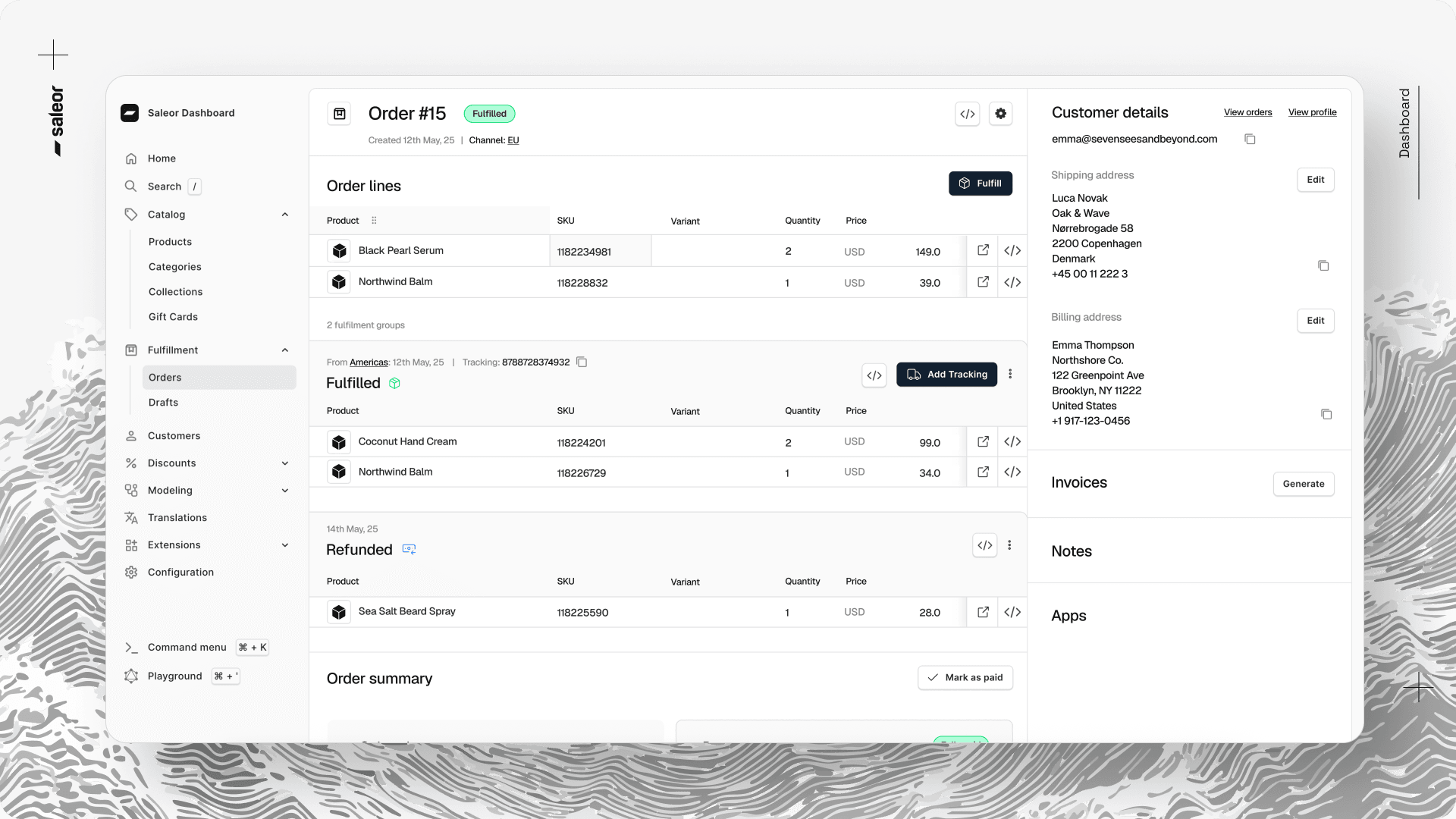
Saleor Dashboard ships as an open-source React app with 45+ extension mount points. Build custom views with any frontend stack — not decorations on someone else's pages.
You don't have to replatform to start
Run Saleor alongside your current platform. Power a new channel, a new market, or a new brand with Saleor while your existing system handles the rest. Migrate at your own pace — if you ever want to.
The best way to evaluate Saleor is to use it
Start a free cloud sandbox, explore the API, or talk to our engineering team. No pitch decks — just commerce infrastructure you can verify yourself.