How We Help Customers Launch with Confidence
Most reliability problems don't happen at launch; they're baked in months earlier. Here's how we help teams avoid them.

When people talk about reliability in commerce, they usually mean infrastructure, monitoring, or on-call procedures. These matter, but most reliability problems start much earlier: with how the project was planned, modeled, and built in the first place.
This becomes especially clear during Q4, when Black Friday and holiday traffic expose every weak decision made months before.
Customer Enablement focuses on helping customers make informed, early choices so their operations are smooth and predictable, rather than stressful.
Reliability starts earlier than most teams expect
For many customers, reliable work begins even before the contract is signed. During pre-sales discovery and solution design discussions, we help map the domain, understand the business rules, and outline the system's structure that will sit on Saleor.
“Saleor visited our office, gave us a workshop, and helped us understand what we actually wanted to build and how it matched our environment, I mean, there can't be a better experience, in my opinion.”
Aykut Çevik, CTO Advisor at

Take a recent example: a rewards platform building a multi-vendor, multi-market setup with custom pricing and offers. Before they wrote any code, we worked with them to figure out how their catalog should be structured, how vendor relationships would map into Saleor, and where their custom services would plug in. Getting this right early meant they didn't have to rearchitect anything later.
An onboarding framework that keeps projects steady
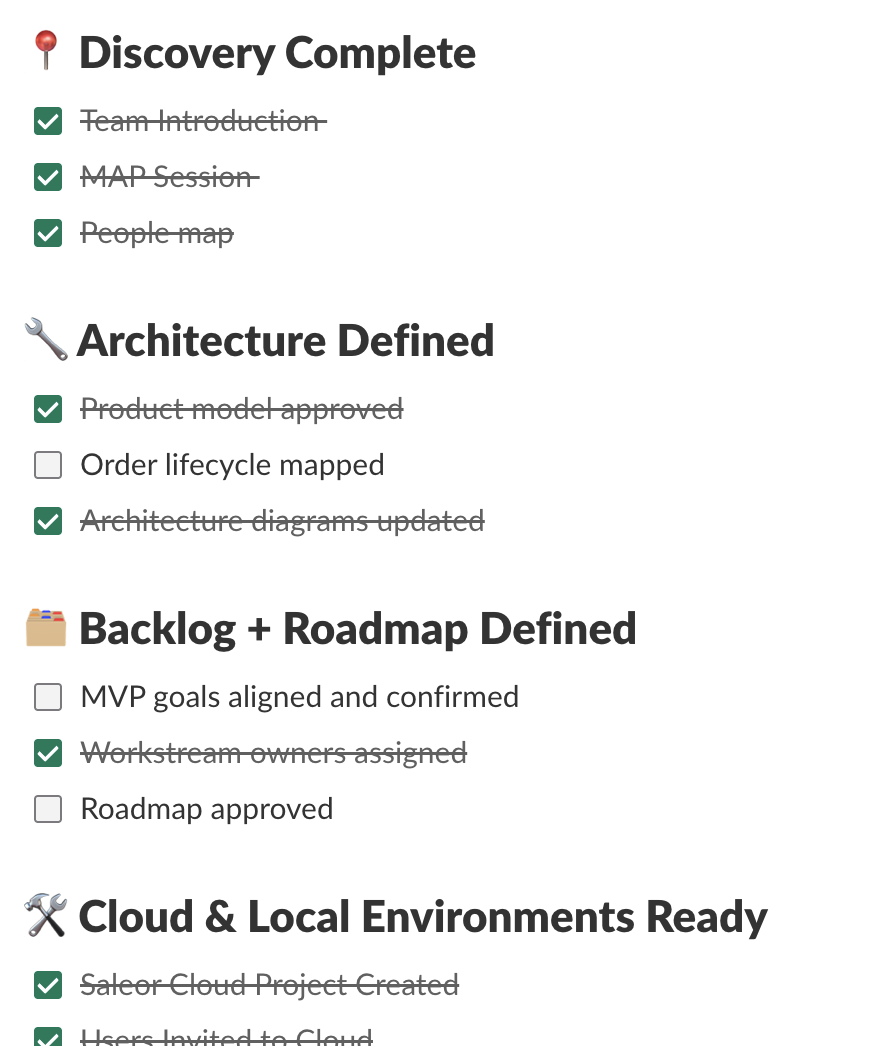
When a project moves from pre-sales to Customer Enablement, we use a milestone-based onboarding framework. This gives everyone a clear structure: what needs to be done, why it matters, and what being "ready" means.
But every team is different. Some customers prefer to go through each milestone with detailed checklists and Slack canvases. Others work better with hands-on pairing sessions and a simpler process, especially technical teams or those working with experienced Saleor partners.
The goal is to use the right amount of structure; enough to keep things stable, not so much that it slows people down. Our go-live framework helps customers with:
Architecture and flow mapping
We help customers plan their architecture and communication patterns so important flows are predictable and can scale as needed.
Catalog and product modeling
We help teams design their catalog structure so it stays manageable, consistent, and performs well in all markets.
Checkout, payments, and webhook patterns
We help customers plan both synchronous and asynchronous flows to prevent blocking and avoid unnecessary connections.
External system connections
We point out possible bottlenecks early and help customers set up their integrations so no part of the system gets overloaded.
Order and fulfillment flow mapping
We help make fulfillment logic clear so it stays reliable and avoids extra webhook noise or complicated state changes.
We catch problems early, when they're still easy to fix. This isn't a one-time review. We're in Slack with teams daily, jumping on calls when they hit blockers, pairing on tricky architectural decisions or even the actual code.
Our customer support team looks out for problems in the system and helps teams fix them quickly. The engineering team monitors systems to catch problems before they affect anyone and fixes them proactively, not just reactively.
All of this collaboration works better when the underlying setup stays consistent across environments. That's where Configurator comes in.
Configurator as a tool for consistency and reliability
Configurator is a CLI tool that helps in creating and managing the data models in Saleor.
Configurator could be seen as a productivity tool, but in practice, it's just as important for reliability. It helps customers:
- Keep catalog and attribute structures consistent
- Avoid configuration drift
- Reduce setup mistakes
- Maintain predictable environments across markets
- Roll out changes in a structured, repeatable way
For complex projects, like multi-vendor, multi-market setups, this kind of consistency is what keeps things from breaking.
The go-live phase brings everything together
As launch gets closer, we focus on validation. Our go-live checklist helps customers check the basics: environment setup, webhook behavior, version readiness, and full UAT flows. This gives a clearer view of launch readiness and helps avoid last-minute surprises.
Since Saleor Cloud moves the validated sandbox environment into production, customers can trust that their setup will work the same way when they go live.
Why this matters
Q4 is when commerce systems face their biggest test. Black Friday, Cyber Monday, holiday season means weeks of sustained load during the holidays.
This is when weak architecture shows up. When bad integration decisions become incidents. When catalog problems that seemed minor suddenly matter.
The work we do early - discovery, onboarding, modeling, go-live prep - often determines whether stores handle peak traffic or break under it.